A new site is live and still being built. Content is updating, stay with us.
ADVOCACY, LAW & HALAKHA
From the feed, to the street, to the Knesset and the Court.
Nivcharot believes state institutions bear responsibility for changing a reality in which Israel's most influential parties are a closed men's club. Alongside awareness work in the community, we act in every arena where decisions are made.
From the legal fight against party bylaws to the halakhic sources themselves: the written answers to whether any legal or halakhic barrier stands in the way of Haredi women's representation.
SUPREME COURT
The battle over party bylaws
In 2019 the High Court gave legal force to Agudat Yisrael’s commitment to remove the word “man” from its membership clause. In 2021 Nivcharot organised a membership drive with programme graduates and community activists. Their applications led to civil claims against Shas in Jerusalem and Agudat Yisrael in Tel Aviv.
The claim that halakha forbids women from being elected was the first wall we hit. To test it we went to the sources and the decisors, and collected the answers.
First ruling
The halakhic pamphlet, 2017
We clarified the halakhic position directly: the pamphlet presents Rabbi Y. Y. Weinberg's 1950 responsum, according to which there are three positions - those who forbid, those who permit, and those who distinguish between voting and standing. It was distributed to rabbis, community figures and the Haredi press.
Six questions that come up in every interview, every home group and every comment thread.
In a survey we published, 59% of respondents said they would like to see Haredi women in the Knesset - 27% "very much" and 32% "somewhat" - against fewer than a quarter opposed. Among secular voters the figure was 65%. On the ground, 14 Haredi women ran in the last municipal elections and two were elected to councils.
Source: Nivcharot survey; ynet, 23 March 2025
No. The halakhic pamphlet we published in 2017 sets out three positions on the question, following Rabbi Y. Y. Weinberg's responsum of 1950: some forbid it, some permit it, and some distinguish between voting and standing for election. It is a dispute, not a flat prohibition.
Source: "Is a woman really forbidden to hold public office?", Nivcharot pamphlet, 2017
Party bylaws and political custom. In 2015 journalist Tal Schneider revealed that the Haredi parties' bylaws entrench the absence of women from their ranks. That is where the legal battle began.
The 2019 ruling concerned the wording of the charter. When women applied in the 2021 membership drive led by Nivcharot, their applications were refused or went unanswered. In December 2025 the court ordered Shas to put an admissions process in place. In October 2026 Agudat Yisrael was given 12 months to establish a membership drive. Each party remains responsible for deciding individual applications.
No. The purpose is an alternative Haredi leadership of women and men alike, equally and respectfully - not to replace Haredi leadership but to widen it.
Sarah Schenirer, who appears in our logo, rejected any feminist label herself and claimed what was due to her "according to the rights the Torah granted us" - and built the first girls' education network in the Haredi world. The question is not what to call it, but who sits at the table.
GATHERINGS
From the street to the Knesset committees
Public protest, the Knesset lobby and home discussion circles: the arenas where Nivcharot gathers people, on the ground and in the community, to move the wall.
2019 elections
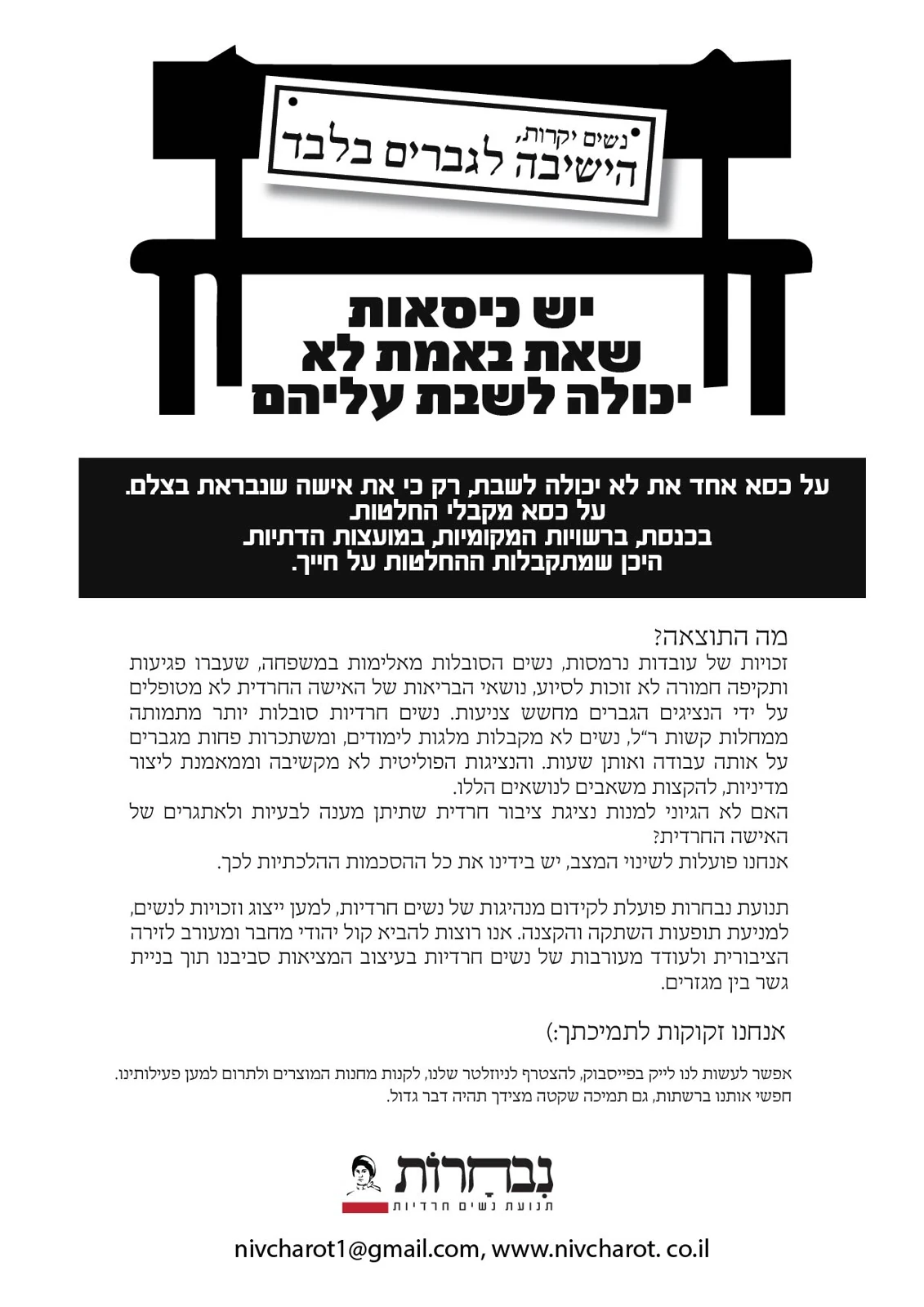
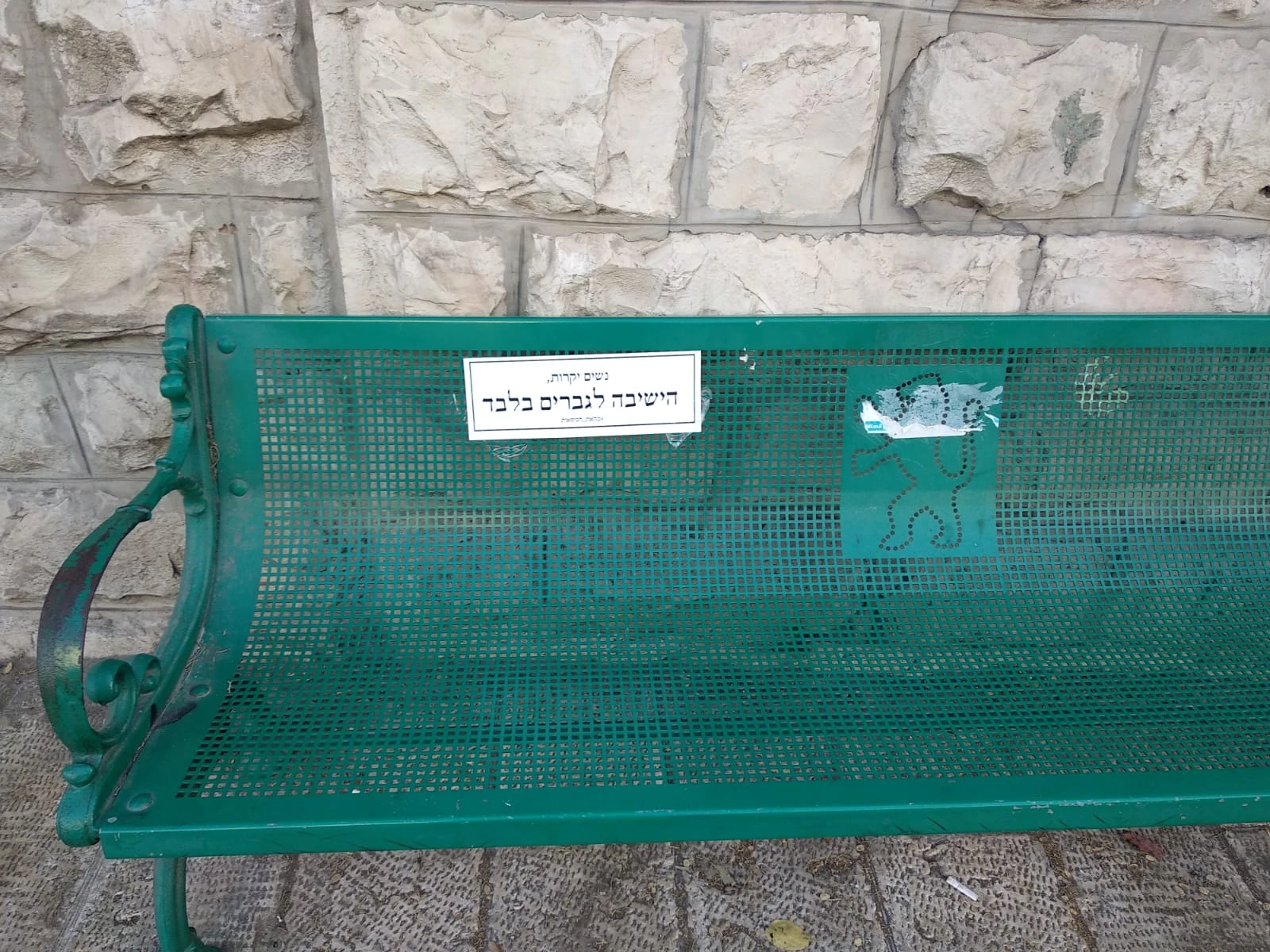
The Empty Chairs protest
Signs on public benches asked passers-by to consider what it meant to reserve seats on a Knesset candidate list for men.
"Lobbyladeinu", the Haredi women's lobby in the Knesset, brings the Haredi women's voice to committees and hearings, from the Committee on the Status of Women to the National Security Committee. Our position papers, on welfare, employment, health and education, go to the Knesset, government ministries and the UN.
COMMUNITY
Sicha circles and home groups
The Sicha project widens the circles of influence to include Haredi men, alongside home groups and community dialogue circles. After October 2023 we helped found "Harediyot Shutafot", Haredi women organizing support for soldiers and the home front.
CAMPAIGNS
Our campaigns
Posts and coverage from Nivcharot’s campaigns.
No Voice, No Vote
Ahead of the election for the 19th Knesset, Esty Shushan started a Facebook page calling on Haredi women to withhold their votes from parties that barred them from standing for election. In December, the press reported on the protest in Mea Shearim, Elad and Bnei Brak. Writing in ynet, Shushan argued that a woman whose vote a party sought should also be able to represent its voters. Nivcharot grew out of this campaign and registered as an association in 2015.
Days before the election for the 22nd Knesset, signs appeared on public benches across Israel reading “Seating for men only.” People took to social media to object. Nivcharot asked why a woman who could take a seat on a public bench could not take one on her own party’s candidate list. The activists called on voters to support parties that included women on their lists.
Campaign film in Hebrew with Hebrew captions · 2 min 13 sec
The poster explaining the protestThe sign on a public bench
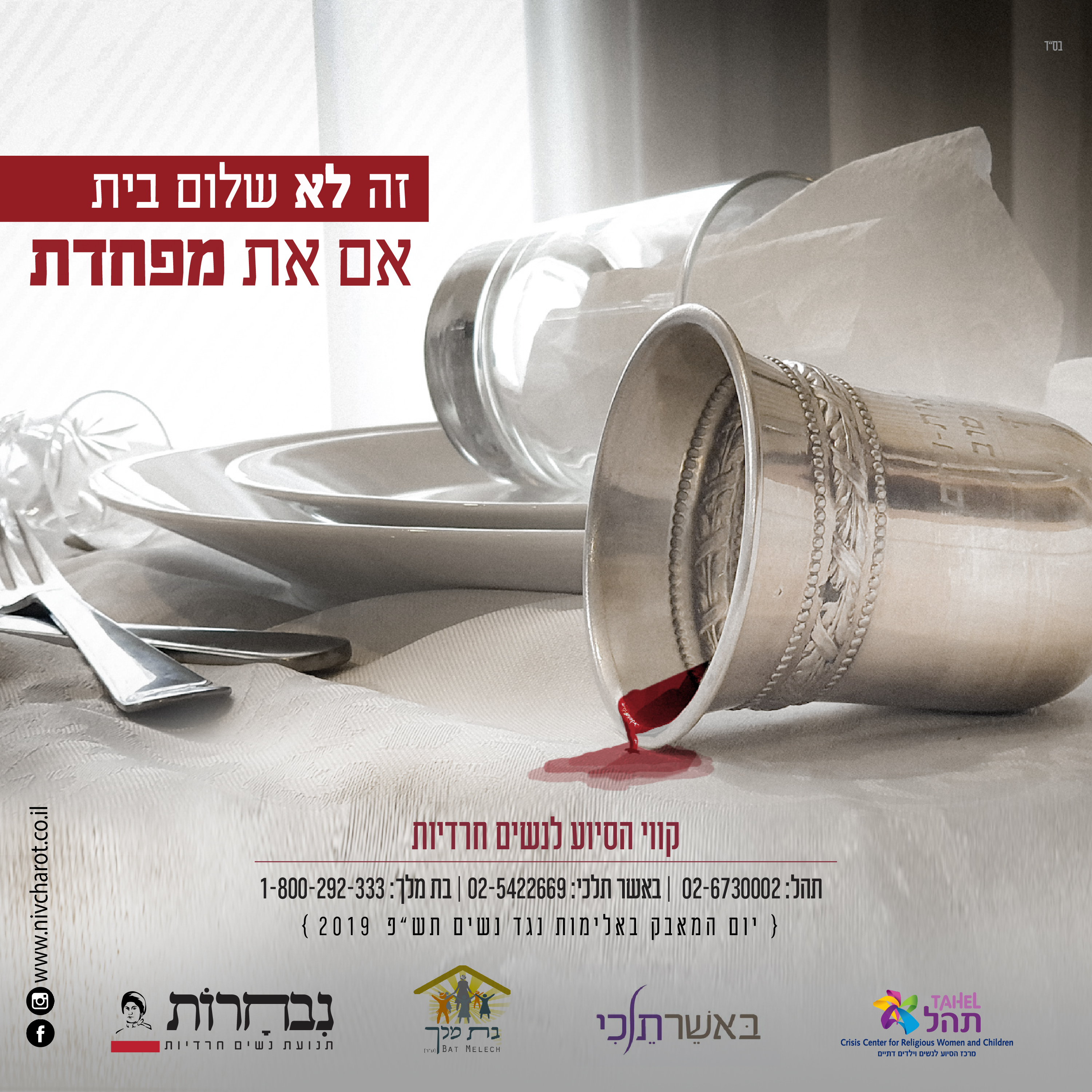
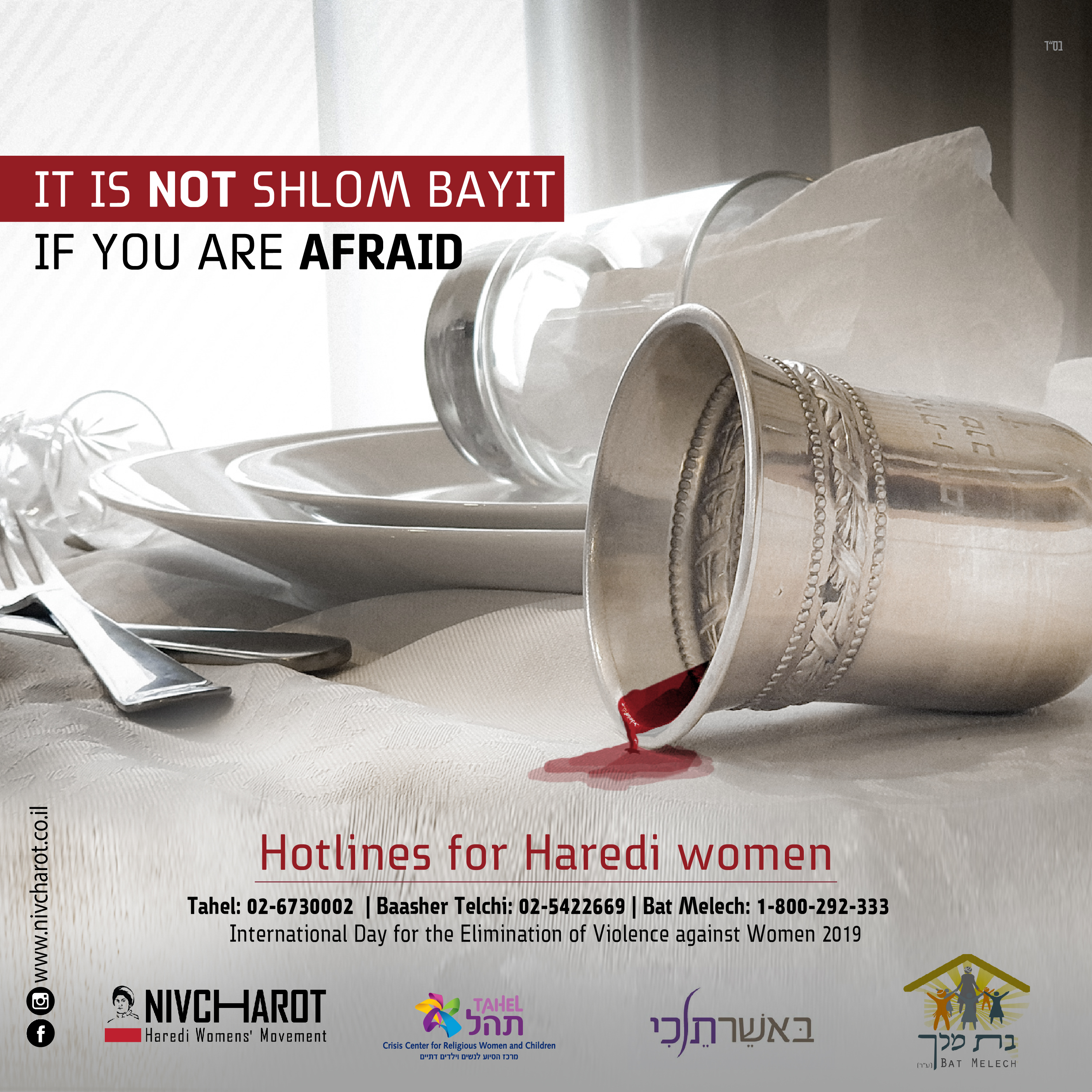
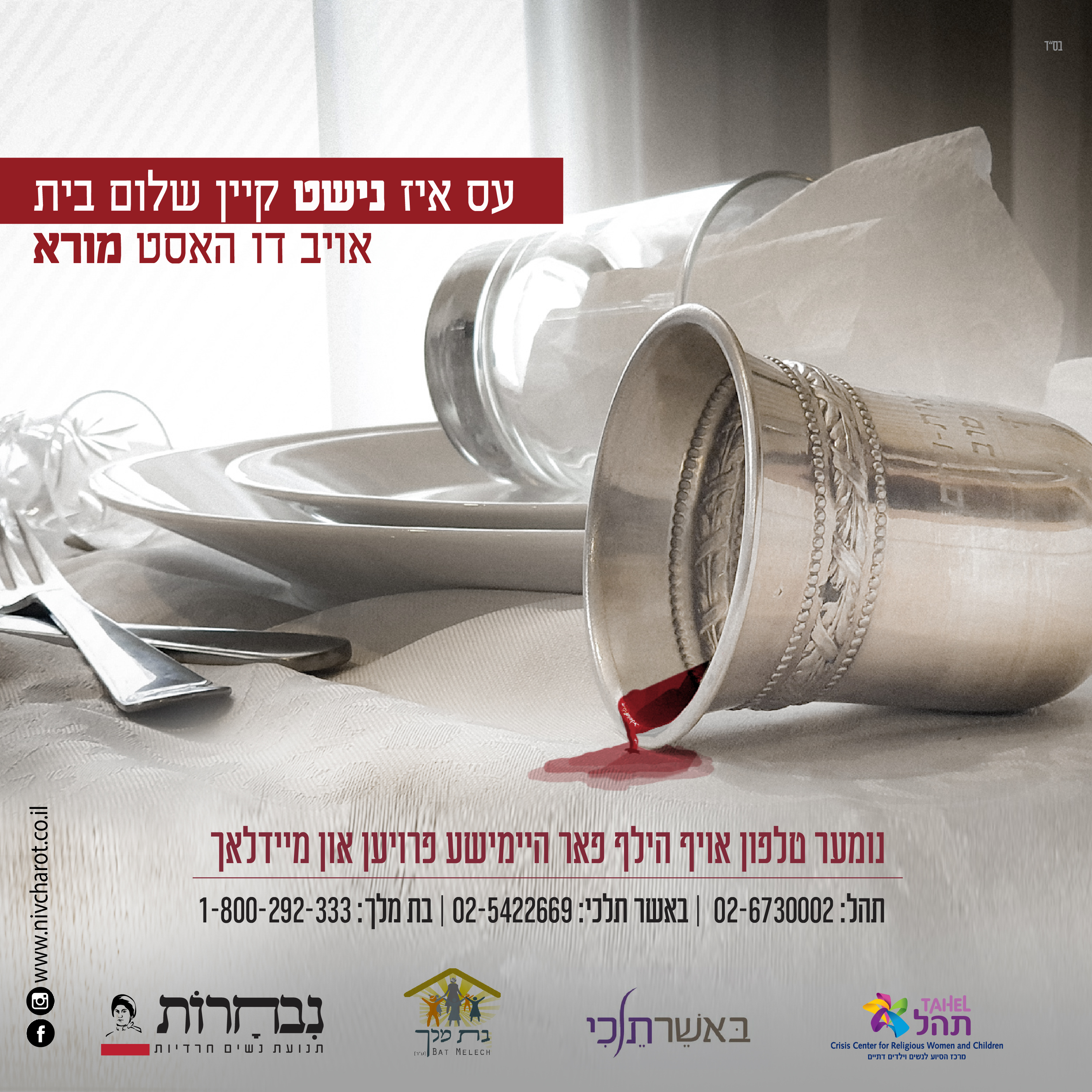
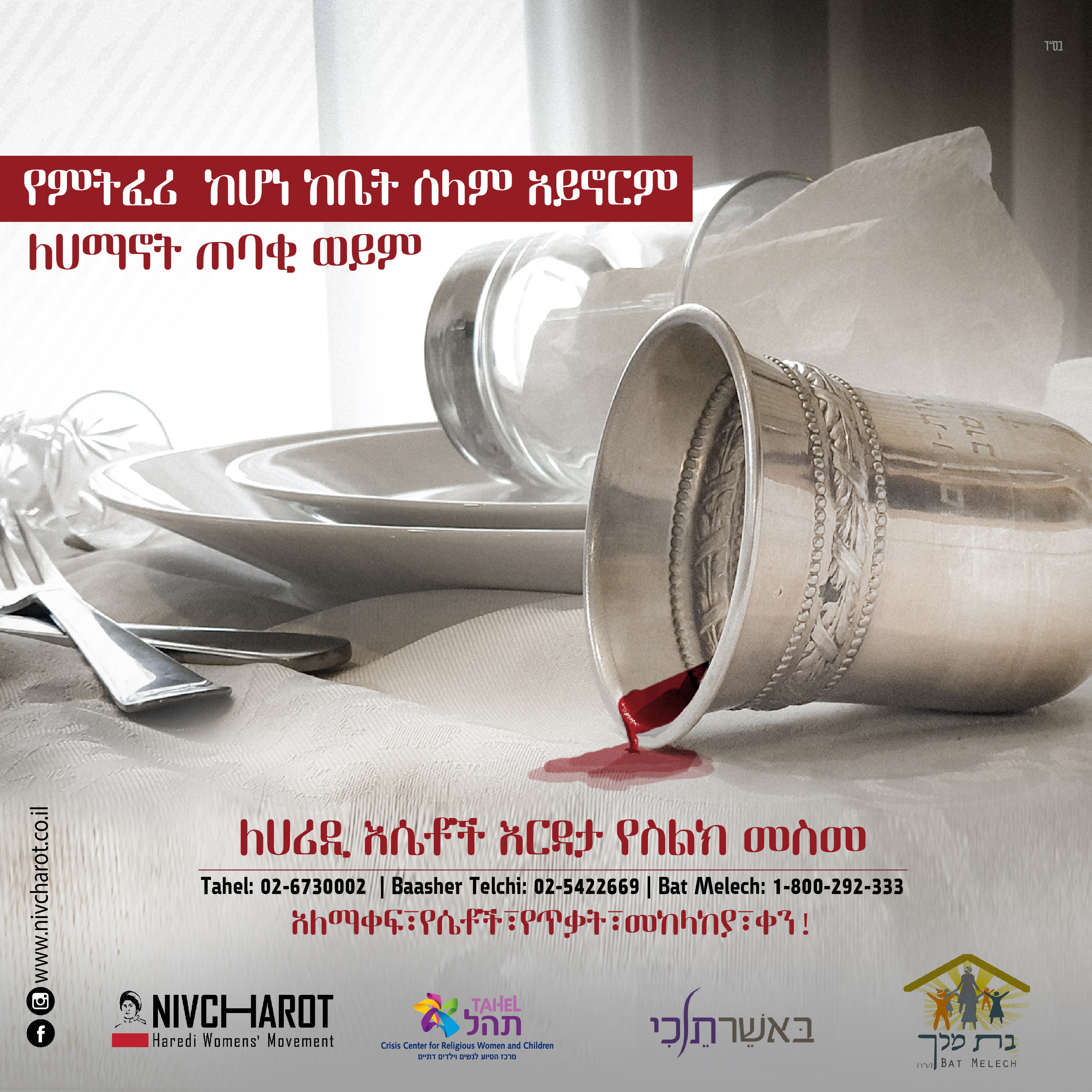
In November 2019, Nivcharot shared posters directing religious and Haredi women experiencing domestic violence to helplines. Bnei Brak municipality declined to allow the posters on the city’s streets.